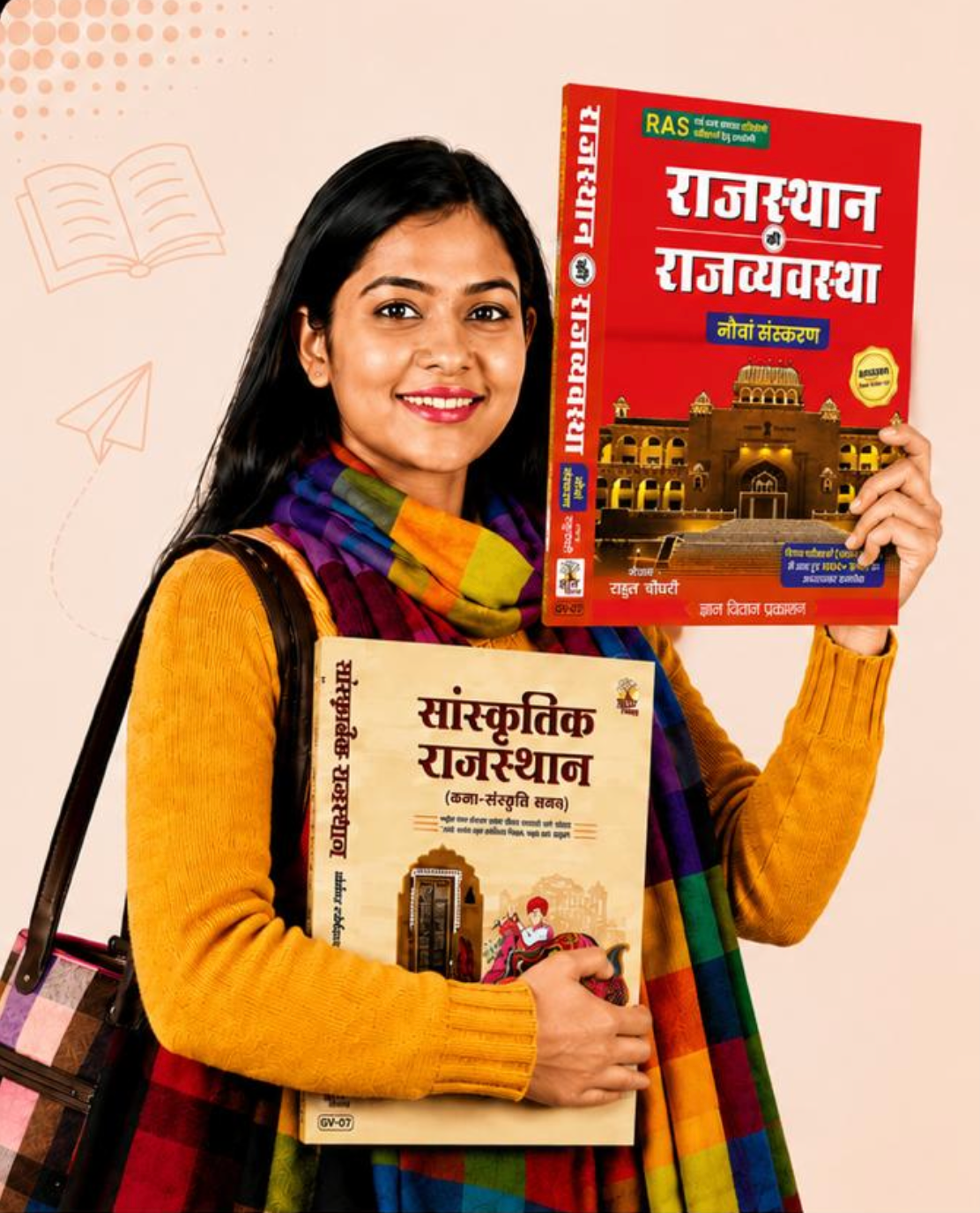

Preparing for a government examination requires more than simply collecting a large number of books and study materials. The real challenge is knowing what to study first, which subjects require more attention, how to select reliable resources, and how to organise preparation according to the examination syllabus. Students often search for the best government exam books, competitive exam books, and competitive exam study material because the amount of information available can become overwhelming. A focused preparation strategy begins by understanding the examination pattern, identifying the important subjects, selecting trustworthy books, and creating a realistic study routine that can be followed consistently.
For students preparing for state-level examinations, the requirement becomes even more specific because the syllabus may include state history, geography, culture, language, current affairs, general knowledge, and subject-specific content. Candidates preparing for Rajasthan government examinations, for example, may need dedicated Rajasthan exam preparation books in addition to general competitive-exam resources. Similarly, candidates targeting teaching recruitment examinations may benefit from specialised Rajasthan teacher exam books that are aligned with the relevant syllabus and question pattern. Gyaan Vitaan Publications focuses on educational and examination-oriented books that can support learners who want structured resources for government and competitive exam preparation. However, books work best when they are combined with syllabus analysis, revision, practice questions, previous-year papers, and a disciplined study plan.
What Should You Study First for a Government Exam?
The first step in government exam preparation should be understanding the official syllabus and examination pattern rather than immediately starting with a textbook. Every competitive examination has different subject weightage, question formats, difficulty levels, and eligibility requirements. Before selecting government exam books, candidates should identify the subjects included in their target examination and divide them into manageable study areas.
Once the syllabus is understood, begin with the subjects that carry significant weightage and require more conceptual preparation. Candidates should avoid spending too much time initially on minor topics simply because they appear easy. Building a strong foundation in core subjects allows later revision and practice to become more effective.
A useful approach is to divide preparation into three broad stages: learning concepts, practising questions, and revising previously studied material. These stages should not be treated as completely separate because regular practice and revision should begin while the syllabus is still being completed.
Why Is the Official Syllabus Important Before Buying Books?
The official syllabus acts as a roadmap for exam preparation. Without it, students may spend valuable time studying topics that are not relevant to their examination while neglecting subjects that carry greater importance.
Before purchasing competitive exam books, compare their contents with the official syllabus. A book may have excellent information but still be unsuitable if it focuses heavily on topics outside the examination’s requirements. Similarly, a book that is too brief may not provide enough explanation for candidates who are building their concepts from the beginning.
Candidates should also check the latest examination notification and official information released by the relevant examination authority because syllabus, pattern, eligibility criteria, and other examination details can change.
How Do You Choose the Right Competitive Exam Books?
Choosing study material should be based on relevance, clarity, accuracy, syllabus coverage, and suitability for your preparation level. The most expensive or largest book is not automatically the best resource. A useful book should explain concepts clearly, organise information logically, and provide material that helps with both learning and revision.
Students should also consider whether they are preparing for the examination for the first time or revising after previous attempts. Beginners may require explanatory books that establish fundamentals, while experienced candidates may prefer concise revision material and practice-oriented resources.
Good competitive exam books should ideally help candidates answer three questions: What do I need to learn? How deeply do I need to learn it? How can I test whether I have understood it?
What Is Competitive Exam Study Material?
Competitive exam study material includes the resources used to understand the syllabus, revise important information, practise questions, and evaluate preparation. Books are an important component, but effective study material can include textbooks, reference books, previous-year question papers, mock tests, notes, current-affairs resources, and subject-specific practice sets.
The quality of study material matters more than quantity. Students sometimes download or purchase dozens of resources and then struggle to complete even one properly. A smaller collection of well-selected books can provide a stronger foundation than an unorganised library of competing resources.
The best study material should support a clear progression from basic understanding to exam-level practice. Candidates should therefore choose resources that complement one another rather than repeatedly covering the same information in different formats.
Which Subjects Should You Study First?
The answer depends on the specific examination, but candidates can generally begin with foundational subjects that appear repeatedly across competitive examinations. General knowledge, reasoning, quantitative aptitude, language ability, general science, current affairs, and examination-specific subjects are common areas, although the exact combination varies.
For state-level examinations, state-specific knowledge can be especially important. Candidates preparing for Rajasthan examinations may need focused preparation in Rajasthan history, geography, culture, art, heritage, polity, economy, and relevant current affairs depending on the examination syllabus.
Rather than studying every subject equally from the first day, assess your strengths and weaknesses. A candidate who is already comfortable with basic reasoning may need less initial time in that area, while someone struggling with quantitative aptitude may need consistent foundational practice.
Why Are Rajasthan Exam Preparation Books Important?
Candidates preparing for Rajasthan government examinations often need resources that specifically address the state’s unique syllabus components. General competitive examination books can help with common subjects, but they may not provide sufficient depth for Rajasthan-specific topics.
Rajasthan exam preparation books can help candidates organise state-related information into areas such as history, geography, culture, administration, important personalities, art, literature, heritage, and other examination-relevant topics. The exact subjects should always be matched against the official syllabus of the target examination.
For serious preparation, students should avoid relying on random internet information alone. A structured book can provide a more organised learning sequence and make revision easier, particularly when the content is presented according to examination requirements.
What Should Rajasthan Teacher Exam Candidates Study?
Teaching examinations require a combination of general examination preparation and education-related or subject-specific knowledge. Candidates may need to study areas such as educational psychology, teaching methodology, child development, language, general knowledge, subject content, and Rajasthan-specific topics, depending on the examination.
This is where specialised Rajasthan teacher exam books can become useful. A dedicated resource can help candidates study topics in a more examination-oriented sequence instead of combining information from unrelated sources.
Candidates should still verify the exact syllabus and current examination pattern before choosing books. A resource should supplement the official syllabus rather than replace it.
How Should Beginners Start Government Exam Preparation?
Beginners should resist the temptation to begin with advanced-level books. The first priority should be understanding basic concepts and becoming familiar with the question style of the target examination.
Start by downloading or reviewing the official syllabus and examining previous-year papers. This provides an understanding of the subjects, recurring topics, question formats, and approximate difficulty level. After that, select one primary book or resource for each major subject instead of purchasing multiple books immediately.
The first few weeks should focus on building consistency. A candidate who studies for a manageable number of hours every day can often create a more sustainable preparation routine than someone who attempts extremely long study sessions for only a few days.
How Important Are Previous-Year Question Papers?
Previous-year papers are among the most useful resources for understanding an examination. They show candidates how concepts are actually converted into questions and help identify recurring themes.
After completing a topic from your government exam books, attempt related previous-year questions. This creates a connection between theoretical learning and actual examination requirements.
Previous-year papers can also reveal whether a candidate has genuinely understood a concept. Reading a chapter may create a feeling of familiarity, but solving questions requires recall, interpretation, and application.
Should You Study Current Affairs Alongside Static Subjects?
Yes, when current affairs are part of the examination syllabus, they should generally be studied consistently rather than left entirely for the final weeks. Current affairs can cover national, international, economic, scientific, sports, government-policy, state-specific, and other relevant developments depending on the examination.
However, candidates should avoid consuming every news story available. The focus should remain on information relevant to the examination syllabus. For Rajasthan-focused examinations, state-specific developments may also deserve attention.
A practical strategy is to maintain concise notes and revise them regularly. The purpose is not to memorise unlimited information but to identify and retain examination-relevant developments.
How Many Government Exam Books Should You Use?
There is no universal number of books that every candidate should follow. In many cases, using one reliable primary resource per subject and supplementing it with practice material is more effective than repeatedly switching between books.
Too many books can create confusion because different resources may explain the same topic differently or include different levels of detail. Candidates may also waste time deciding which source to trust.
A better strategy is to select a primary source, complete it systematically, mark important information, practise questions, and use additional resources only when a specific topic requires clarification.
What Makes a Good Government Exam Book?
A useful government exam book should be accurate, clearly organised, relevant to the examination, and easy to revise. It should avoid unnecessary complexity while providing sufficient depth for the target syllabus.
Candidates should consider whether the book has a logical chapter structure, useful examples, relevant practice questions, updated information where necessary, and a presentation style that supports repeated revision.
For state-level and teacher examinations, syllabus alignment is particularly important. A book that is specifically designed around the relevant examination can reduce the amount of time candidates spend filtering unrelated information.
How Can Gyaan Vitaan Publications Support Exam Preparation?
Gyaan Vitaan Publications can be included in a candidate’s preparation strategy as a source of examination-oriented educational books and study resources. For students looking for government exam books, competitive exam books, or specialised preparation material, the value of a publication should ultimately be judged by how well its content matches the learner’s syllabus and study requirements.
For Rajasthan-focused learners, resources related to Rajasthan’s history, culture, general knowledge, education, and examination-specific subjects can help organise preparation more effectively. Students considering Rajasthan exam preparation books or Rajasthan teacher exam books should compare the available titles with the latest official syllabus before selecting the most relevant resources.
The most effective use of any publication is systematic. Instead of buying a book and leaving it unused, candidates should read the relevant chapters, make concise revision notes, solve practice questions, and return to difficult topics during revision. This transforms a book from a passive reference source into an active preparation tool.
How Should You Make a Daily Study Plan?
A daily study plan should be realistic rather than unnecessarily complicated. Candidates should divide their available study time between concept learning, question practice, revision, and current affairs where applicable.
For example, a learner may begin the day with a difficult conceptual subject, move to question practice later, and reserve some time for revision. The exact schedule should depend on personal circumstances, examination date, preparation level, and subject difficulty.
Consistency is more important than copying another student’s timetable. A study plan that can be followed for several months is generally more useful than an extremely demanding schedule that becomes difficult to maintain.
Four Essential Steps for Choosing Exam Books
Check the Syllabus: Make sure the book covers the subjects and topics required for your specific examination.
Review Previous-Year Papers: Use actual question papers to understand the depth and style of questions you need to prepare for.
Choose Limited Primary Resources: Avoid collecting too many books; select reliable resources that you can complete and revise.
Prioritise Revision and Practice: A book becomes useful when you repeatedly revise its important concepts and apply them through questions.
How Can You Use Books More Effectively?
Simply reading a book from the first page to the last is not always the most effective preparation method. Competitive examinations require active recall and application, so candidates should interact with the material.
Underline or mark only genuinely important information. Write short notes for difficult concepts instead of copying entire paragraphs. After studying a chapter, close the book and try to recall the major points. Then solve questions related to that topic.
Revision should also become progressively shorter. The first study session may require detailed reading, while later revisions should focus on important facts, formulas, concepts, mistakes, and previously difficult questions.
What Role Does Mock Testing Play in Preparation?
Mock tests help candidates evaluate whether their preparation can be converted into performance under time pressure. A student may understand a subject but still struggle with speed, question selection, accuracy, or time management.
Mock tests should therefore be introduced before the final examination stage. Initially, candidates can use topic-wise tests and gradually move towards complete examination-style papers.
After every mock test, analyse incorrect answers rather than simply checking the score. Identify whether the mistake occurred because of insufficient knowledge, misunderstanding, calculation, careless reading, or time pressure. This analysis can guide the next round of study.
How Can You Avoid Information Overload?
Information overload is a common problem during competitive exam preparation. The internet provides unlimited videos, PDFs, notes, quizzes, and recommendations, but consuming more information does not necessarily produce better preparation.
Candidates should create a defined resource list and follow it consistently. If a new book or video is discovered, ask whether it provides something genuinely necessary that the current resource does not.
A focused preparation system might include one primary book per subject, previous-year papers, selected current-affairs resources, mock tests, and short revision notes. The exact combination can vary, but the principle remains the same: study fewer resources more thoroughly rather than many resources superficially.
How Important Is Revision for Government Exams?
Revision is essential because competitive examinations often require candidates to recall large amounts of information within a limited time. Reading a topic once is rarely enough for long-term retention.
A useful revision cycle can begin shortly after the initial study and become increasingly spaced over time. Difficult topics may require more frequent revision, while familiar subjects can be reviewed less often.
Revision should also include mistakes from practice tests. A mistake log can become one of the most valuable personal study resources because it identifies exactly where improvement is required.
Common Mistakes Students Make When Selecting Study Material
One major mistake is selecting books only because they are popular. Popularity does not necessarily mean that a book is appropriate for every examination or preparation level. Another common mistake is choosing resources without checking the syllabus.
Some students also change books repeatedly whenever they find a difficult chapter. Instead of switching immediately, they should first determine whether the problem is the resource itself or whether the concept requires additional explanation.
Another mistake is neglecting practice. Reading competitive exam study material without solving questions creates an incomplete preparation process. The final examination measures the candidate’s ability to answer questions accurately under pressure, so practice must be integrated into daily preparation.
Can One Book Be Enough for a Competitive Exam?
In most competitive examinations, depending on only one book for the entire syllabus may not be sufficient. However, candidates can often benefit from selecting one strong primary resource for each major subject and then supplementing it with question papers, mock tests, and targeted references.
The goal should not be to find one magical book that guarantees success. No book can replace consistent preparation, practice, revision, and understanding of the examination pattern.
A well-selected book becomes valuable when it fits into a larger preparation strategy.
FAQs
Which books should I study first for government exams?
Start with books that cover the core subjects in your official syllabus. First understand the examination pattern, then select reliable subject-wise resources. Prioritise foundational concepts before moving to advanced practice and revision material.
What are the best competitive exam books for beginners?
The best books for beginners are those that explain fundamental concepts clearly, follow the relevant syllabus, and provide enough practice to build confidence. Candidates should select resources according to their specific examination rather than relying on a generic bestseller.
What is competitive exam study material?
Competitive exam study material includes books, notes, previous-year papers, mock tests, practice questions, current-affairs resources, and other educational resources used for examination preparation. Books should form part of a structured preparation strategy rather than being used in isolation.
Are Rajasthan exam preparation books necessary for state-level exams?
They can be useful when the examination includes Rajasthan-specific subjects such as history, geography, culture, heritage, polity, economy, or other state-related topics. Always compare the book’s contents with the latest official syllabus.
Which books are useful for Rajasthan teacher exam preparation?
Rajasthan teacher exam books should be selected according to the specific teaching examination and its official syllabus. Candidates may need resources covering teaching methodology, child development, language, subject knowledge, general awareness, and Rajasthan-specific topics, depending on the examination.
Conclusion
Choosing the right government exam books is an important part of competitive examination preparation, but the number of books you own is far less important than how effectively you use them. A strong preparation strategy begins with the official syllabus, continues with carefully selected competitive exam books and competitive exam study material, and becomes stronger through previous-year papers, regular practice, revision, and mock testing.
For candidates preparing for Rajasthan-focused examinations, dedicated Rajasthan exam preparation books can help organise state-specific subjects, while Rajasthan teacher exam books can provide focused resources for candidates preparing for teaching-related recruitment examinations. Resources from Gyaan Vitaan Publications can be considered as part of this structured approach, provided that candidates match each book with their current syllabus and preparation level.
The most important principle is simple: do not study everything; study what your examination actually requires, study it thoroughly, practise it regularly, and revise it repeatedly. With the right books, a realistic timetable, active practice, and consistent revision, candidates can make their preparation more organised and purposeful while avoiding the common problem of information overload.